Phone: 541-375-0522
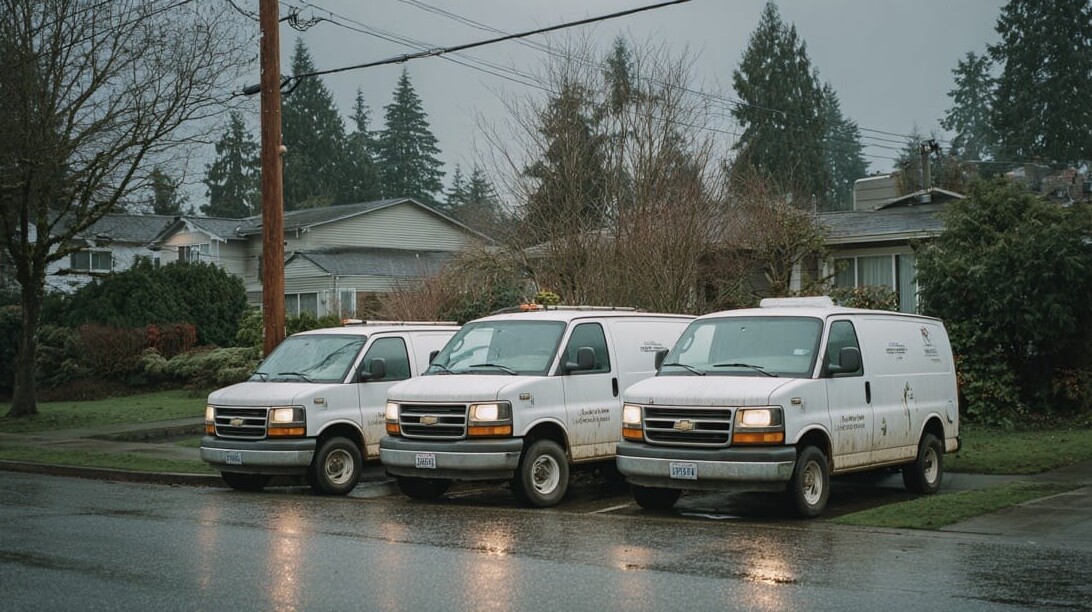
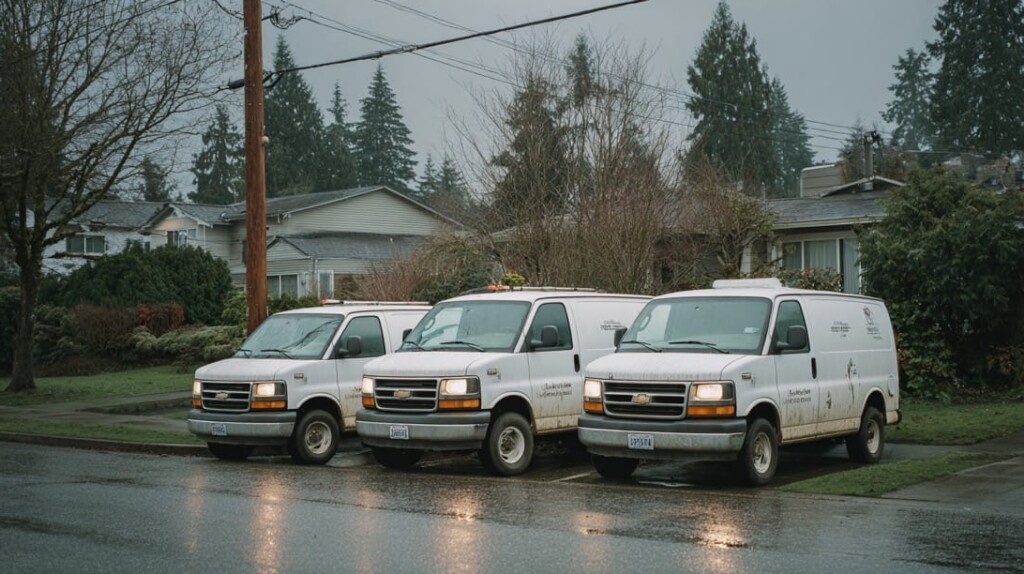
A homeowner needs a contractor. She asks a neighbor, gets two names, Googles a few more. She pulls up three websites. All three have a stock photo of a smiling couple standing in front of a house none of these contractors have ever touched. All three say some version of “Quality Work. Fair Prices. Free Estimates.” All three have a contact form and a phone number she hasn’t called yet.
She schedules estimates with all three.
You show up. Your work is excellent. Your price is fair. But your truck has a faded magnetic sign, your estimate arrives as a generic PDF, and your website — if she went back to check — has eleven Google reviews and a gallery of finished projects with no context about who did the work, how long it took, or what problem it solved.
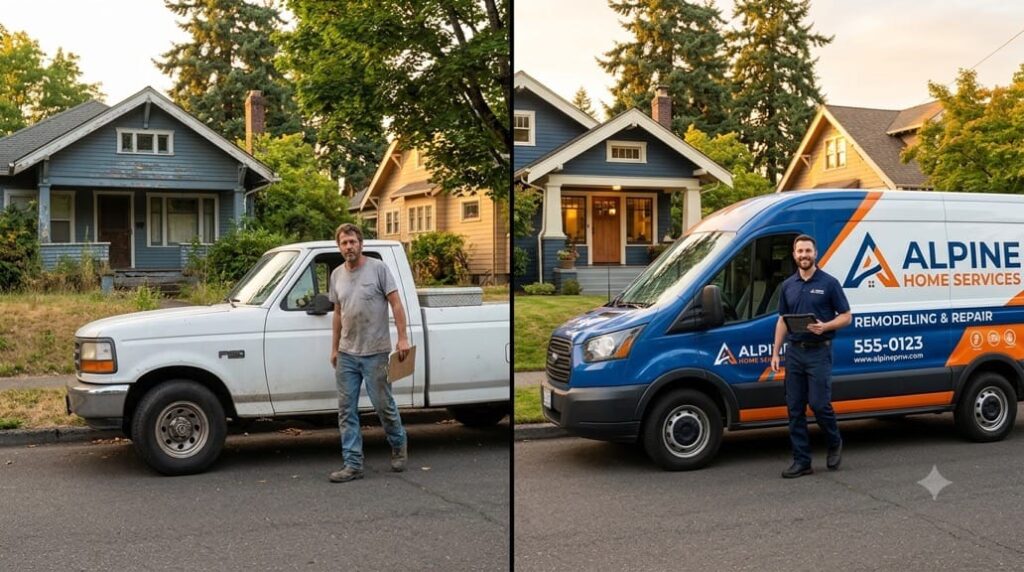
The contractor who wins the job has 94 reviews, a wrapped truck she recognized from two streets over last week, and a website that walked her through the before, the process, and the after of every project. His price was slightly higher than yours.
That gap isn’t skill. It’s brand. And it’s costing contractors far more than any single lost bid.
What the $10,000 Mistake Actually Looks Like
This isn’t one bad call you can trace to a specific afternoon. It’s a slow bleed across every touchpoint a homeowner encounters before she ever picks up the phone.
Most contractors think of branding as a logo — something a designer handled once, probably years ago, filed away and forgotten. But your brand is everything a potential client sees, hears, and registers before she decides whether to trust you with her home. For most contractors, every one of those touchpoints sends the same forgettable signal as every competitor in town.
Your Brand Identity Is Sending a Signal — Here’s What It’s Saying
Walk through what a homeowner actually sees when she’s sizing you up. Your truck pulls up. Is it wrapped with your name, your trade, and something that reads as professional and established? Or does it have a magnetic sign that’s slightly off-center and a phone number in a font that looks like it was chosen in a hurry?
Your crew gets out. Are they in branded shirts that say this is an organized operation, or a mix of personal clothes that makes the whole thing feel informal?
She goes to your website. Are there real photos of your actual team doing actual work, or does it open with a stock image of a couple who have never met you? Does your homepage tell her something specific about why you’re the right contractor for her specific problem, or does it say some variation of the same four words every other contractor in your market uses?
These aren’t vanity concerns. They’re the signals her brain processes to answer one question: Can I trust this person with my home? When those signals look identical to your competitors’, she has no way to answer that question except by looking at the number at the bottom of your estimate.
The Website Mistakes That Kill Your Close Rate Before the Estimate Arrives
Your website is where most homeowners decide whether to call you or move on. And most contractor websites make the same handful of mistakes that collapse that decision before it gets started.
The headline problem is the most common. “Family-Owned and Operated Since 1987” tells her nothing about what you’ll do for her. “Licensed, Insured, and Ready to Serve You” is true of every contractor she’s considering. These phrases don’t differentiate — they disappear.
The photo problem runs close behind. Finished project photos are better than nothing, but they show the destination without the journey. Homeowners don’t just want to know what your work looks like when it’s done. They want to understand your process — see that you keep a clean jobsite, that you communicate during the project, that hiring you won’t turn their home into a stressful construction zone for three months. Most contractors show the finished product. The ones who win show everything in between.
Then there are the missing trust signals homeowners scan for and don’t find. License numbers. Insurance documentation. A physical address. Real team photos. Warranty details. These aren’t extras. They’re the credibility infrastructure that makes a homeowner feel safe saying yes.
Why Generic Branding Turns Every Conversation Into a Price Negotiation
Price sensitivity isn’t really about price. It’s about perceived value. And perceived value is built — or destroyed — before you show up to give an estimate.
When a homeowner can’t identify a meaningful difference between three contractors, she doesn’t flip a coin. She uses the only comparison tool she has: the number at the bottom of each estimate. You haven’t given her anything else to work with.
This is where the race to the bottom starts. Not with a competitor who undercuts you. With a brand that gives homeowners no reason to choose you before they see your price.
The frustration contractors voice most often isn’t “my prices are too high.” It’s “nobody understands why we’re worth it.” But that understanding doesn’t happen on the sales call. It gets built into every touchpoint before you arrive — the truck she noticed two weeks ago, the website she browsed at 10pm, the 94 reviews she read before scheduling, the social post that showed her exactly how carefully your team protects a client’s floors during a gut renovation.
When those pieces are in place, the estimate conversation changes. She’s not comparing numbers. She’s confirming a decision she already mostly made.
The Differentiation Strategy That Stops the Price Shopping
The fix starts with one question most contractors have never seriously answered: Why should a homeowner choose us specifically?
“We do great work” doesn’t count — every contractor says that. “We’ve been in business 20 years” doesn’t count either — so has the company two miles away. The answer has to be specific enough that a competitor couldn’t copy it word for word and have it still be true about them.
Write a USP That Actually Means Something
The formula is simple: your trade, your specific client, a concrete benefit, and proof.
A roofing contractor in the Pacific Northwest isn’t just “a roofer.” He could be the contractor who has “Protected Oregon Homes From Heavy Rain Damage for 25 Years.” A remodeler isn’t just someone who does quality work. She could be the one who specializes in “Helping Busy Families Remodel Without Living in a Construction Zone” — which tells a specific homeowner with kids and a full schedule exactly why to call her and not the other guy.
Notice what those do. They name a specific benefit for a specific person in a way that’s memorable and checkable. Generic branding can’t replicate that, because generic is, by definition, unspecific.
What Your Trucks and Uniforms Communicate Whether You Like It or Not
A wrapped truck with your name, trade, and a clean visual identity tells people you’re established and worth remembering. It works while your crew is on the jobsite, while the truck is parked at lunch, and while you’re driving to the next estimate. That’s not an expense — it’s a moving billboard you’re already paying to operate.
The same applies to uniforms, yard signs, and jobsite presentation. Branded shirts tell homeowners the people in their house represent an organized company. A clean jobsite with a visible yard sign keeps building name recognition with every neighbor who walks past.
Consistency across all of it is what makes your brand feel real rather than improvised.
The Four Things Google Looks For — and Homeowners Do Too
Google’s framework for evaluating which businesses deserve to rank — Experience, Expertise, Authoritativeness, and Trustworthiness — maps almost exactly onto what homeowners look for when they’re deciding who to hire. Build for both at once.
Experience: Show the Work, Not Just the Result
Premium contractor brands don’t post a photo of a finished kitchen and call it marketing. They document the problem the homeowner came to them with, the process they used to solve it, the complications that came up mid-project, and how they handled them. Before-and-after galleries are a starting point. Walkthrough videos, jobsite photos, and client interviews are what actually build the trust that gets someone to pick up the phone already decided.
Expertise: Be the Educator, Not Just the Estimator
Contractors who dominate their local markets publish content that answers the questions homeowners are already searching before they hire anyone. What does a roof replacement cost in your city? What are the signs of foundation trouble specific to your region’s soil? What should a homeowner ask before letting any contractor start work on their home?
When you answer those questions clearly and specifically, you stop being a vendor and start being a resource. By the time a homeowner calls, she doesn’t feel like she’s evaluating you. She already trusts you. The estimate is almost a formality.
Authoritativeness: Stop Burying Your Credentials
Certifications, trade association memberships, manufacturer partnerships, awards, years in business — most contractors have these and hide them on an About page nobody reads. The ones who build real authority put credentials on dedicated pages, reference them in content, and make them visible at every stage of the homeowner’s decision process.
Authority compounds. Every review, every published article, every visible credential builds on the last. A contractor who’s been building that foundation for two years is nearly impossible for a newcomer to compete with on anything except price — and by then, price matters a lot less to the clients worth having.
Trustworthiness: The Checklist Homeowners Run Through Before They Call
Your license number should be on your website. Your insurance should be easy to find. Your team should have real photos, because homeowners want to know whose face will show up at their door. Your reviews need to be recent, numerous, and visible — a contractor with eight reviews from 2019 looks like a contractor who stopped caring in 2019.
Trust is usually the deciding factor when homeowners choose between two contractors at similar price points. Unlike skill — which a homeowner often can’t assess until the job is done — trust signals are visible, verifiable, and entirely within your control.
The Reputation Formula That Attracts Better Clients
Reviews aren’t just social proof. They’re pre-sold trust. A homeowner who finds you with 90-plus reviews and reads through several of them arrives at the estimate differently than someone who found you cold. She’s already leaning toward you. The conversation you’re walking into is different.
That dynamic compounds into something even more valuable: referrals that don’t require asking. When your brand is strong enough that clients feel proud to recommend you, your marketing budget starts working less hard. Reviews accumulate faster. Close rates improve. The leads who do come in are less likely to open with “can you beat this other quote?”
That’s what the shift actually looks like — not a dramatic overnight change, but a gradual replacement of price-driven conversations with clients who already know what they want and have decided it’s you.
Check These Seven Things Before You Do Anything Else
Walk through each touchpoint honestly:
- Trucks and fleet — Does your vehicle branding look intentional, or improvised?
- Website headline — Does it name a specific benefit, or could any competitor use the exact same line?
- Project gallery — Does it show your process, or just finished work?
- Google Business Profile — Complete, optimized, stacked with recent reviews?
- Social media — Consistent brand voice and visuals, or sporadic posts with no through-line?
- Trust signals — License, insurance, warranty details, and real team photos visible and easy to find?
- Your USP — If a competitor used your tagline tomorrow, would anyone notice? If not, it needs work.
Most contractors find two or three places where they’re functionally invisible. That’s not a character flaw. It’s an inherited habit from an industry where everyone does the same thing and hopes craftsmanship speaks for itself.
It doesn’t. Not until people can find you, trust you, and remember you.
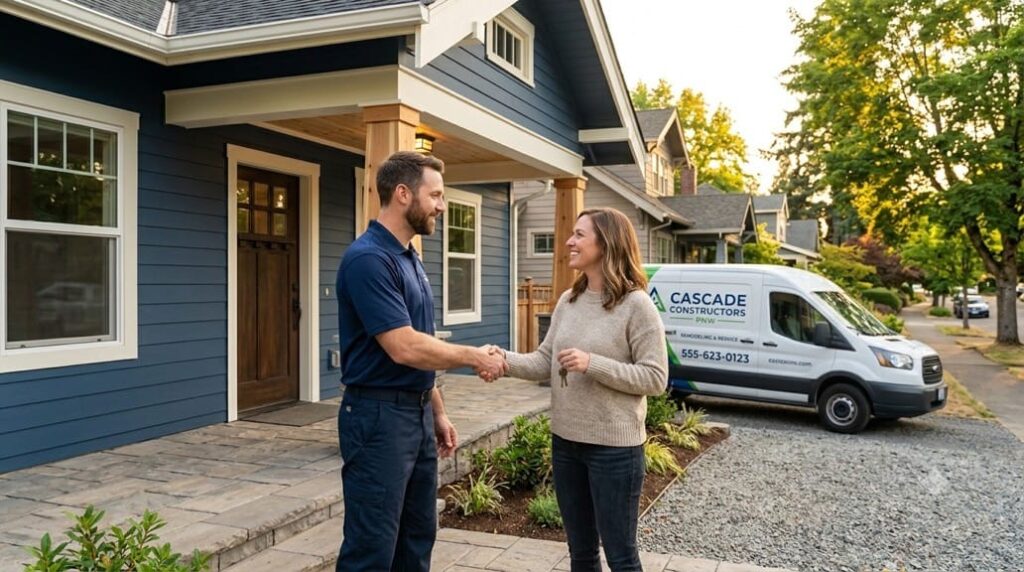
The Conversation That Changes When Your Brand Does
Go back to that homeowner from the opening. She didn’t choose the best contractor. She chose the one who felt like the safest, most established, most trustworthy option based on everything she saw before the estimates landed on her kitchen table.
The contractor who won that job understood something the others didn’t: the job is won or lost before anyone shows up.
Fix the brand — the trucks, the website, the reviews, the credentials, the photos, the USP — and the sales conversations you walk into start to change. Fewer people opening with “can you beat this other quote?” More people asking “we’ve been following your work and we’d like to use you — when are you available?”
The $10,000 mistake isn’t spending money on the wrong marketing. It’s leaving that money on the table every time a homeowner picks a competitor because she couldn’t see a reason not to. Building that reason is entirely within your control.